
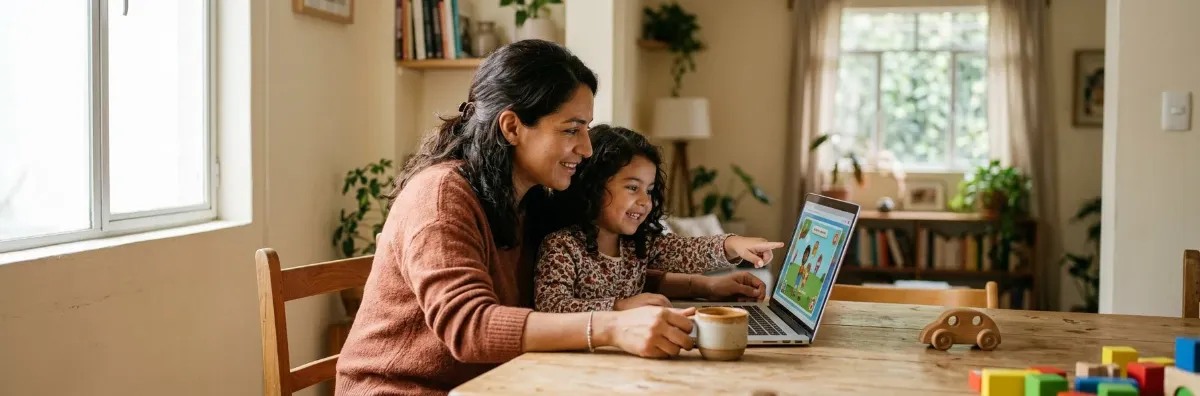
If you’ve typed the words “my child isn’t talking” into a search bar at midnight, you are not alone. It’s one of the most common things parents bring to us at Oasis Speech, and also one of the most misunderstood. Two terms come up again and again: speech delay and language delay. Most people use them interchangeably, but knowing the difference can genuinely change the course of your child’s care.
The #1 Question Parents Ask
“Is my child just a late talker?” It’s a fair question, and, the answer is: sometimes yes, sometimes no. What helps us figure that out is understanding whether we’re looking at a speech issue, a language issue, or both.
A child who is a “late talker” might have all the ideas in the world, they understand what you say, they know what they want, but the words just aren’t flowing yet. Another child might produce sounds all day long but struggle to follow a two-step instruction or tell you what happened at playgroup. These are very different profiles. And they call for very different support.
Speech is ‘how’ we talk. Language is ‘what’ we say and understand. A child can have a difficulty with one, the other, or both — and each one matters.
Know the difference
Speech delay vs. language delay
A child can have both.
What Is a Speech Delay?
Speech is about the physical act of making sounds, the clarity and accuracy of what actually comes out of your child’s mouth. When we talk about a speech delay, we’re talking about difficulty with the mechanics: forming sounds correctly, being understood by the people around them, or producing words without a lot of struggle.
Think of it like this: your child has the words in their head. They want to say ‘rabbit.’ But what comes out is ‘wabbit’ or maybe just ‘abit.’ The idea is there. The pathway to getting it out clearly isn’t quite working yet.
SIGNS THAT MAY POINT TO A SPEECH DELAY
WATCH FOR THESE SIGNALS
- By 18 months, few or no recognizable words
- Speech that is hard for even family to understand past age 3
- Consistently leaving off the ends of words, even familiar ones
- Substituting or omitting sounds in a way that makes speech unclear
- People outside the family cannot understand most of what your child says by age 4

Speech delays can be linked to things like articulation disorders or phonological disorders. And here’s an important thing to hold onto: a child with a speech delay can have completely intact language. They may understand everything you say and have rich, complex thoughts, they’re just working hard to get those sounds out clearly.
What Is a Language Delay?
Language is bigger. It covers everything we communicate, understanding words, following instructions, building sentences, asking questions, retelling events, and expressing wants, needs, and ideas. There are two sides to it:
• Receptive language is what your child takes in and understands
• Expressive language is what your child says and communicates
A language delay means one or both of those areas isn’t keeping pace. And the thing is a child with a language delay might have perfectly clear speech. Every sound might be crisp and correct. But they may have a very small vocabulary, use only single words well past the expected age, or look genuinely confused when you give a two-step instruction.
SIGNS THAT MAY POINT TO A LANGUAGE DELAY
WATCH FOR THESE SIGNALS
- At 12 months, not responding to their name or simple words like ‘no’ or ‘bye-bye’
- At 18 months, not pointing to objects or pictures when named
- At 2 years, not putting two words together (‘more milk,’ ‘daddy go’)
- At 3 years, unable to follow a two-step instruction
- Difficulty telling a simple story or explaining what happened at school
Why the Difference Matters for Treatment
The type of delay shapes the entire approach to therapy. A child with a speech delay typically works on articulation: practicing specific sounds, building coordination, learning to produce speech more clearly. A child with a language delay needs something different, building vocabulary, strengthening comprehension, expanding sentence structure, practicing communication in real-life situations.
The exercises look completely different. The goals look completely different. Which is exactly why a proper evaluation, one that looks at both speech and language, is the essential first step. You can’t build a roadmap without knowing where the gaps actually are.

Think of it this way: if your child’s glasses prescription is wrong, stronger lenses won’t help. The same is true here. The right therapy, targeted to the right delay, makes all the difference.
Age Milestones to Keep in Mind
Every child develops at their own pace. But milestones exist for a reason — they tell us roughly what most children are doing at a given age, and they help us spot when a child might benefit from a closer look.
| Age | Speech Milestones | Language Milestones |
| 12 Months | Babbles with different sounds (ba-ba, da-da) | Responds to name, understands ‘no’ and ‘bye-bye’ |
| 18 Months | Uses words for common objects, actions and people | Points to pictures when named, follows 1-step instructions |
| 2 Years | Speech may still be unclear to others | Puts 2 words together; has 50+ word vocabulary |
| 3 Years | Clearer speech; says p, b, m, h, w, d and n correctly | Uses word combinations often; asks why and how |
* These are general guidelines. Consistent gaps across multiple milestones, or a strong gut feeling that something is off, are worth discussing with a speech-language pathologist.
When to Seek an Evaluation
Trust your instincts, and act early.
Research consistently shows that early intervention leads to significantly better outcomes for children with speech and language delays. Waiting to see if a child “grows out of it” sometimes works. But sometimes it means missing the most receptive window for support, the years when a child’s brain is most ready to build these skills.
An evaluation doesn’t mean something is terribly wrong. It means you’re getting clarity. It means you’ll walk away with answers and if your child does need support, a plan that actually fits where they are.
Whether you’re mildly curious or genuinely worried, a speech and language evaluation can assess both areas. We’ll look at how your child produces sounds, how they understand language, how they express themselves, and whether anything needs attention. Then we’ll talk you through it.
Quick Comparison: Speech Delay vs. Language Delay
| Speech Delay | Language Delay | |
| What it affects | Sound production, clarity, articulation | Vocabulary, comprehension, sentence structure |
| Example sign | Hard to understand at age 3 | Not combining words at age 2 |
| Child may… | Have clear ideas but unclear sounds | Speak clearly but say very little |
| Treatment focus | Articulation, phonological therapy | Vocabulary, comprehension, expression |
| Can a child have both? | Yes | Yes |
Not Sure Where Your Child Falls?
Our evaluations assess both speech and language — so you get the full picture, and a plan that actually fits your child. We’re here when you’re ready.
Book Free ConsultationSherry Owais, M.A., CCC-SLP, is the founder of Oasis Speech and a licensed speech-language pathologist serving children and adults in Texas and Florida via telehealth.
Related: Online speech therapy for kids, language disorder therapy for children and online speech therapy in Fort Worth, TX.



 Texas Medicaid and CHIP
 Community Plan (Medicaid)
 Step Up For Students