

Voice Disorders
Your child's hoarse voice doesn't have to be normal. Telehealth speech therapy teaches healthy voice habits from home.
Your child comes home from school and their voice sounds raspy or hoarse. You think maybe they've been yelling on the playground. But days pass, and their voice doesn't bounce back. Or maybe your child's voice always sounds strained or tired — they're frequently losing their voice, or it sounds rough no matter what.
Most parents don't think much about voice disorders. We focus on whether kids are talking, not how they sound while talking. But voice quality matters — both for communication and for protecting developing vocal cords from damage.
Voice disorders in children are often preventable and highly treatable. With telehealth speech therapy, you can get expert guidance from home on how to protect your child's voice and help them develop healthy vocal habits.
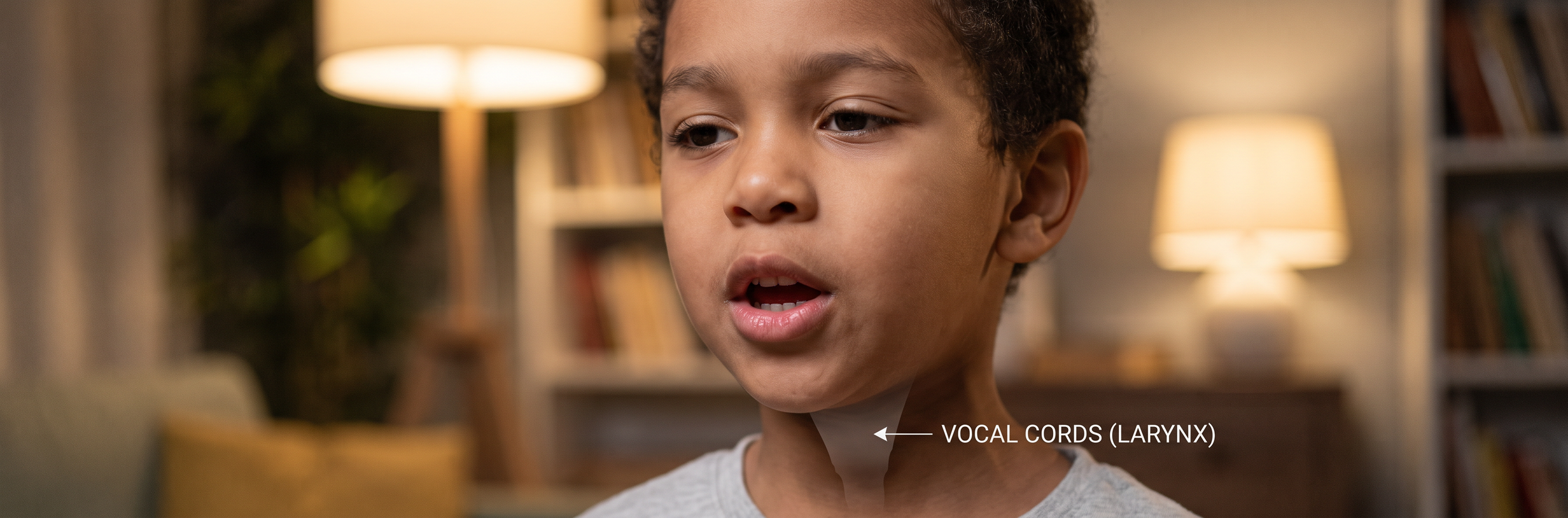
What is a Voice Disorder?
Voice is the sound produced by the vocal cords (vocal folds) in the larynx when air passes through them. A healthy voice sounds clear, strong, and doesn't require effort to produce.
A voice disorder is when the quality, pitch, or loudness of the voice is different from typical voices, or when voice production causes discomfort or pain.
Voice disorders in children can sound like:
Hoarseness or roughness — A gravelly, scratchy quality to the voice.
Breathiness — The voice sounds weak or breathy, like there's not enough power behind it.
Nasality — The voice sounds like the child has a cold, with air escaping through the nose.
Strain or tension — The child sounds like they're working hard to produce voice, with visible tension in the neck or face.
Pitch problems — The voice is too high or too low for the child's age or gender, or the pitch wavers.
Loudness issues — The child can't speak loudly enough to be heard, or they're always yelling.
Frequent voice loss — The child regularly loses their voice or becomes hoarse.

Red Flags: When to Seek Help
Warning signs that warrant evaluation:
Hoarseness or roughness lasting longer than 2 weeks
Voice that sounds different from other children the same age
Child complains of pain, scratching, or discomfort when speaking
Visible tension in the neck, face, or jaw when speaking
Frequently loses their voice or becomes hoarse
Voice fatigue — child's voice gets worse throughout the day
Other children comment on or tease about their voice
Voice interferes with participation in school, sports, or activities
Recent onset of voice changes after illness (cough, cold)
Excessive yelling, screaming, or loud voice use
Breathing difficulties associated with voice changes
Important: Some voice disorders (like vocal nodules or polyps) develop from voice abuse or misuse — yelling too much, screaming, harsh coughing, or chronic throat clearing. These are preventable with behavior change and proper voice use.

Why Do Voice Disorders Happen?
Voice disorders in children can arise from several causes:
Vocal abuse or misuse — The most common cause. Children who yell excessively, scream during play, engage in loud sports cheering, or make harsh sounds repeatedly can damage their vocal cords. Over time, this can lead to nodules (benign growths) or other voice problems.
Illness or infection — Laryngitis from colds, flu, or other viral infections can temporarily affect voice. Sometimes the hoarseness persists after the illness clears.
Allergies or reflux — Post-nasal drip or acid reflux irritate the vocal cords, causing hoarseness.
Tension and stress — Muscle tension in the neck, jaw, and throat can restrict voice production and create a strained quality.
Anatomical differences — Rarely, voice disorders are caused by structural differences in the larynx or vocal cords.
Neurological issues — In some cases, voice problems are related to neurological conditions affecting muscle control.
Environmental factors — Dry air, secondhand smoke, or excessive voice use in loud environments can irritate vocal cords.
Sometimes there's no clear "why" — A comprehensive telehealth evaluation can help identify the cause and guide treatment.
How Telehealth Speech Therapy Helps
Telehealth is highly effective for voice disorders because:
Your therapist sees your child's natural voice patterns. Voice problems often vary depending on the situation — your child might sound worse when tired, excited, or at school. A telehealth therapist observes how your child actually uses their voice at home, in real life, giving a clearer picture than clinic-based testing.
Voice therapy focuses on behavior change. Most voice disorders improve through changing voice use habits. A telehealth therapist coaches you on how to help your child reduce yelling, use proper breathing, relax tension, and develop healthier vocal habits — during everyday moments at home.
Parent coaching is key. You're with your child all day. During telehealth sessions, your therapist shows you exactly how to remind, model, and reinforce healthy voice use: "Use your big voice when you need to be heard, not by yelling," or "Take a breath before you talk." This real-world coaching makes behavior change stick.
Less pressure, more progress. Kids often tense up in clinical settings, which makes voice problems worse. At home, via video, your child is relaxed and their voice is more authentic.
Consistent support. Regular telehealth therapy without missed appointments due to travel means your child gets consistent guidance on voice health.
Most children with voice disorders see significant improvement within 4–8 weeks of consistent voice therapy, especially when parents are actively reinforcing healthy voice habits.

What You Can Do Right Now
While you're thinking about an evaluation, here's what helps:
Model healthy voice use. Children learn by watching. Speak at a comfortable volume, breathe naturally, and don't yell unnecessarily. Show your child what a relaxed, healthy voice sounds like.
Reduce yelling and screaming. Encourage your child to use their "big voice" (clear and strong) rather than yelling (strained and loud). Explain the difference: "A big voice is strong. Yelling hurts our throat."
Teach breathing awareness. Before speaking, take a breath. Show your child: breathe in, then speak on the exhale. This powers the voice without strain.
Encourage hydration. Drinking water throughout the day keeps vocal cords lubricated. Make water available and encourage regular sips.
Reduce voice strain triggers. Minimize chronic coughing, throat clearing, or whispering. If your child has seasonal allergies, manage them. Avoid smoky environments.
Give voice rest. If your child is hoarse, encourage quiet activities. Avoid excessive talking, singing, or shouting until the voice recovers.
Don't punish voice problems. If your child loses their voice or sounds hoarse, stay calm and supportive. Tension and stress make voice disorders worse.
Watch for signs of pain. If your child complains of throat pain, discomfort when swallowing, or neck pain, mention it to a doctor or speech-language pathologist.
The Bottom Line
If your child's voice sounds different, rough, or strained, or if they're frequently hoarse or lose their voice, it's worth getting evaluated. Voice disorders are common and treatable — and early intervention prevents voice damage and teaches healthy vocal habits that benefit your child for life.
Telehealth speech therapy makes it easy to access expert voice coaching from home, where your child is most comfortable and where real behavior change happens.
Ready to Get Answers?
At Oasis Speech, we evaluate children for voice disorders via telehealth and help them develop healthy, strong voices — all from the comfort of your home. We complete evaluations within one week and work with families throughout Florida and Texas via secure video sessions. No waiting lists. No commute. No guesswork.
Your child will work with Sahar Owais, MS, CCC-SLP, a licensed speech-language pathologist with extensive experience helping children develop healthy vocal habits and restore voice quality. Sessions are engaging, play-based, and tailored to your child's specific needs. You'll be right there, coached live on how to support healthy voice use every day through modeling, positive reinforcement, and practical voice-care strategies.