
Online Speech Therapy for Toddlers and Late Talkers
Helping toddlers say their first wordsput two words togetherbe understoodask for what they want
Speech delay therapy by live video for toddlers, late talkers and children with delayed speech across Texas and Florida, one-on-one with a licensed speech-language pathologist.
Evening and weekend therapy appointments available
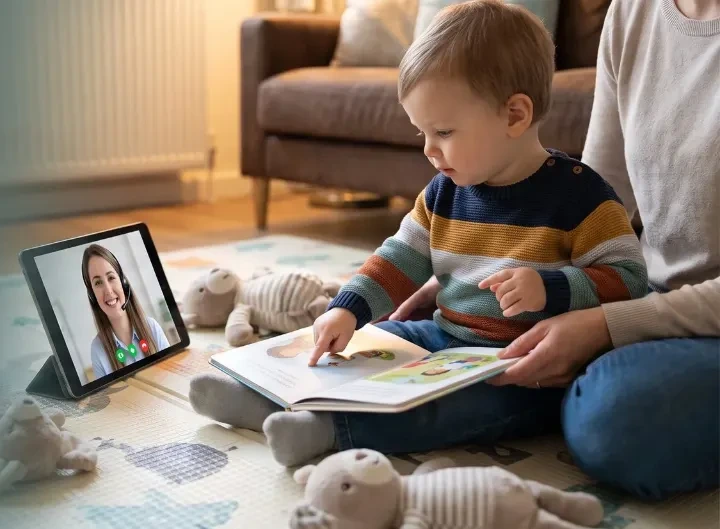
“I was skeptical at first of doing virtual therapy but it has helped my little one so much. He has said many new words with Ms. Sherry’s help.”

Your therapist
Sherry Owais, M.A., CCC-SLPLicensed speech-language pathologist in Texas and Florida.On this page
Key points
Speech delay, in brief
- A speech delay means your child is developing speech and language, but more slowly than expected for their age.
- Speech delays are common and often very treatable.
- Early help makes a real difference, because the brain is most able to learn and change in the early years.
- How long therapy takes depends on the child. Some catch up within a few months.
Your 18-month-old is a late talker, saying only a few words while other toddlers seem to be forming sentences. Your 2-year-old understands everything you say but rarely speaks. Or maybe your 3-year-old talks, but nobody outside the family can understand them.
You’re wondering: Is this normal? Should I be worried? When should I call someone?
If you’re asking these questions, you’re not alone. Speech delays are one of the most common developmental concerns parents bring to their pediatrician. The good news? Early intervention works. And getting answers is simpler than you might think.
The basics
What Is a Speech Delay?
Also called delayed speech or late talking.
A speech delay means your child is developing speech and language skills, but at a slower pace than expected for their age. This is different from a disorder — a delay means they’re on the developmental path, just not moving along it at the typical speed.

Speech delays can involve one or more areas.
The key thing to understand is that speech delays are common, often very treatable, and early help makes a real difference.
Causes
Why Does Speech Delay Happen?
Speech delays can have many different causes, and sometimes there’s no single clear reason.
- Some speech delays run in families.If you or your partner talked later as a child, or if there’s a family history of speech or language differences, your child is more likely to have a delay too. This doesn’t mean something is wrong — it’s just a pattern you’ll see.
- Hearing loss, even partial, can delay speech development.If your child isn’t hearing words clearly, they can’t learn to produce them clearly. Ear infections, especially frequent ones early in development, can affect speech learning. If hearing is a concern, your pediatrician can refer you for a hearing test.
- Limited language exposure can contribute to delays.Children learn language from the people around them. If your child spends most of their time with just one caregiver, or if family members don’t talk to the child often, language development may slow.
- Developmental differencesAutism, cerebral palsy, Down syndrome and other conditions can affect speech development. In these cases, speech delay is often one of several developmental concerns.
- Selective mutismA child speaks comfortably in some settings (like at home) but cannot speak in others (like at school) because of anxiety. It can look like a speech delay, but it is a different concern.
- Sometimes, there’s no clear cause.Your child is developing normally in every way except their speech is slower. This is common, especially in late talkers under age 2, many of whom catch up on their own.
Signs by age
Signs of Speech Delay: When to Seek an Evaluation
Not all children talk on the same timeline, and some catch up without help. But certain signs suggest an evaluation is worth pursuing.
Tap any sign you are seeing.
- 12 months
By 12 months, most children babble (“baba,” “dada”), respond to their name, and wave or point.
- 18 months
By 18 months, children typically have some words and understand simple words and instructions.
- 2 years
By 2 years, most children have at least 50 words and put two words together, like “more milk” or “daddy up.”
- 2½ to 3 years
By 2.5 to 3 years, others can understand much of what your child says, and your child follows two-step directions.
- At any age
At any age, losing words or skills your child once had is always worth checking.
Seeing one or more of these? A free 15-minute call is a simple first step.
Book Free ConsultationTrust your gut. If something feels off to you, and especially if relatives or teachers have mentioned concerns about your child’s speech, an evaluation provides answers and peace of mind.
This list is a guide, not a diagnosis. At any age, losing skills they once had is a red flag.
The evaluation
What Happens During a Speech Evaluation
A speech evaluation is simply a way to understand what’s happening with your child’s speech and language development. It’s not stressful — most of it looks like play.
Child evaluations typically take 30 to 60 minutes
- Case historyDevelopmental and medical background.Your speech-language pathologist will start with questions about your child’s history. When did your child say their first word? Do they have ear infections? Is there family history of speech delays? How does your child communicate at home?
- ObservationThe SLP watches communication in natural, play-based activities.Then the SLP will play with your child in age-appropriate activities. They might stack blocks, read a book, play with toys, or engage in activities that naturally bring out communication. This is casual and natural — your child doesn’t feel like they’re being tested.
- Standardized testsAge-appropriate assessments.The SLP will use standardized assessments designed for your child’s age. These are researched tools that measure speech and language skills in ways that are reliable and fair.
- Goals and next stepsA plain-language plan for what comes next.After the evaluation, you’ll get a detailed report. It explains what your child’s strengths are, what areas are delayed, and whether speech therapy is recommended. If therapy is recommended, the report explains what therapy will focus on, how often sessions should take place, and what you can do at home.
Why early
Early Intervention Speech Therapy: Why It Matters
Early intervention is one of the most important concepts in speech development. It means getting help sooner rather than later, and the research is clear: it works.
- When children receive speech therapy early, they have a greater chance of catching up to peers.
- The brain is most plastic — most able to learn and change — in the early years. Therapy during these years takes advantage of this incredible capacity.
- Early intervention often means therapy is more efficient and effective.
Read more in our guide to why early intervention matters before age 3.
Timeline
How Long Does Speech Delay Therapy Take?
This is one of the most common questions parents ask, and the honest answer is: it depends on your child and the nature of the delay.
Telehealth
Speech Therapy for Speech Delay, Online
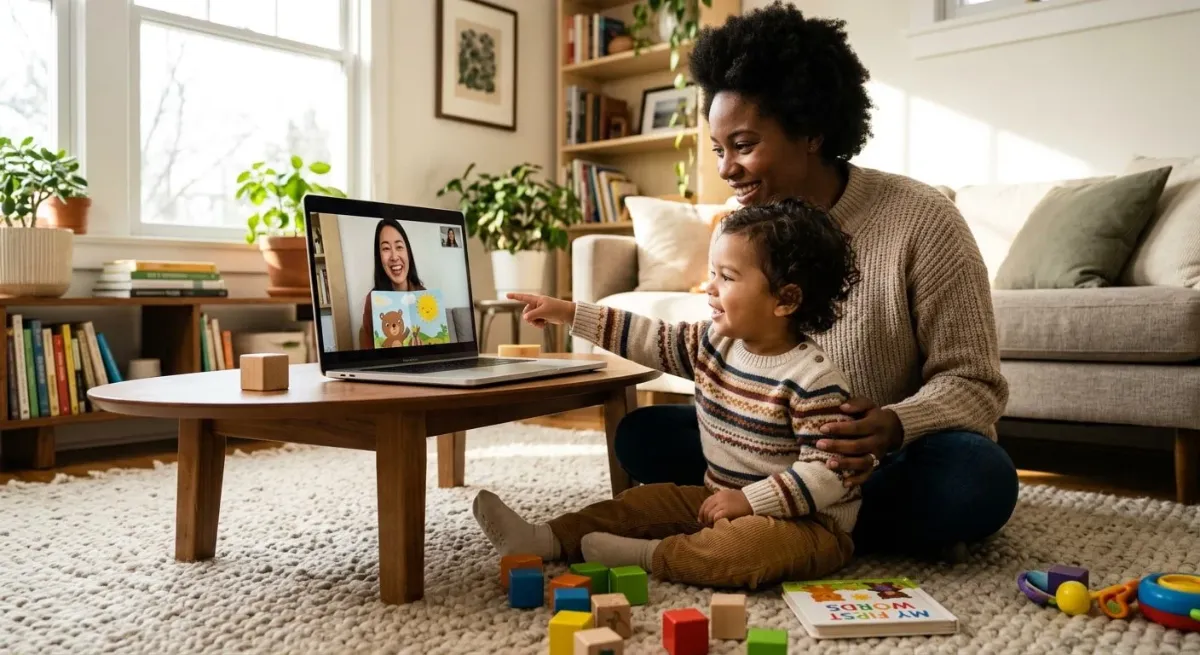
At Oasis Speech, our licensed speech-language pathologist provides online speech therapy for toddlers and children with speech delays across Texas and Florida. Sessions happen through secure, HIPAA-compliant video from the comfort of home — where your child already feels relaxed and ready to talk.
- Telehealth also puts you right beside your child during every session.
- You’ll see the exact strategies we use, so you can practice them at home throughout the week.
- For young children with speech delays, parent involvement is one of the biggest drivers of progress.
Not sure if your child needs help? Book a free 15-minute consultation, and we’ll talk through your concerns and next steps together.
At home
How to Help Your Toddler Talk at Home
You don’t need special materials or training to support your child’s speech development. You’re already doing most of what matters.
- Talk to your child throughout the day.Narrate what you’re doing: “Now we’re putting on your shoes.” “We’re eating lunch.” This constant language exposure is powerful. Your child learns by hearing language used naturally in context.
- Read books together every day.Point to pictures, ask questions, let your child turn pages. Books introduce new words and ideas in a fun, engaging way.
- Follow your child’s lead.If your child is interested in trucks, talk about trucks. If they want to play with blocks, talk about what you’re building. Learning happens when your child is engaged and interested.
- Expand on what your child says.If your child says “dog,” you say “Yes, that’s a big dog! The dog is running.” You’re modeling how to say more while respecting what your child contributed.
- Ask questions that invite communication.“What’s that?” “Where did the ball go?” “What do you want?” These open-ended questions encourage your child to use language.
- Play together.Silly games, peek-a-boo, singing songs — these aren’t just fun; they’re language learning. Your child learns through play and enjoyment.
- Choose people over shows.Children learn language from people. Live video with a therapist is real interaction; cartoons are not.
Insurance accepted
Insurance for Speech Delay Therapy in Texas and Florida
In Texas, we accept STAR, STAR Kids, and CHIP plans through UnitedHealthcare Community Plan and BCBS of Texas in certain areas, plus BlueCross BlueShield of Texas, Aetna, and Curative. In Florida, we accept Aetna, UnitedHealthcare, Curative, and Step Up For Students.
In Texas

 Including HealthSelect

 Traditional Texas Medicaid



Medicaid plans vary by county. Check yours with our Texas Medicaid and CHIP plan checker, or see insurance details →
In Florida
 Including Dual Complete
 Step Up For Students
We aren’t in network with Florida Medicaid or Florida KidCare plans right now. We accept HSA/FSA funds and provide superbills for out-of-network reimbursement. See insurance details →
We verify your benefits before the evaluation and tell you what to expect. Self-pay is available in both states. See insurance and pricing →
Getting started
Three steps. No waiting room.
- Free consultationA free 15-minute call. Tell us what you are noticing, and ask anything.
- EvaluationA licensed speech-language pathologist finds out what is going on and writes a plan.
- Sessions at homeLive 25 to 30 minute video sessions, at a time that fits your week.
Google reviews
What families say
We cannot thank Mrs. Sherry Owais enough for the incredible impact she had on our son. From day one, she created a welcoming and supportive environment that instantly put him at ease. She is highly knowledgeable, patient, and truly cares about her patients. Not only did she help our son make amazing progress with his speech, but she also provided our family with great support and strategies to practice at home. We highly recommend her services to anyone seeking speech therapy!
Oasis speech did an amazing job with scheduling and communication for my sons sessions. … she was so patient with him and really had him engaged. thanks oasis speech!
Very professional and helpful with my case and situation
Ms. Sherry is so amazing. I was skeptical at first of doing virtual therapy but it has helped my little one so much. He has said many new words with Ms. Sherry’s help. We look forward to each session ☺️
Questions parents ask
Speech Delay and Late Talker FAQ
When should I worry that my toddler is not talking?
Talk with a speech-language pathologist if your child has no words by about 15 to 18 months, fewer than 50 words by age 2, or is not combining two words by age 2.
Is my child a late talker or is it something more?
An evaluation looks at understanding, play, gestures and sounds as well as words. That full picture shows whether your child is likely to catch up or needs support.
Should we wait and see?
Waiting is rarely the best plan. Early support is linked with better outcomes, and an evaluation gives you clear information either way.
Can speech therapy for toddlers work online?
Yes. Toddler sessions use parent coaching: the therapist shows you what to do during play and daily routines, and you practice between sessions.
What are the signs of speech delay?
Common signs include no babbling or gesturing by 12 months, few or no words by 18 months, fewer than 50 words or no two-word phrases by age 2, and speech that is still very hard to understand between 2½ and 3 years. Losing words or skills at any age is always worth checking.
How can I help my toddler talk at home?
Talk through your day, read together every day, follow your child’s lead in play, expand on what they say, and ask questions that invite an answer. Practicing these strategies with you between sessions makes a bigger difference than therapy alone.
What is the difference between an expressive and a receptive language delay?
With an expressive language delay, a child understands more than they can say. With a receptive language delay, a child has trouble understanding words and directions. Some children have both, and an evaluation shows which areas need support.
Every Voice Deserves to Be Heard
Book a free 15-minute consultation with a licensed speech-language pathologist. No obligation.