
Is Online Speech Therapy as Effective as In-Person? What the Research Says
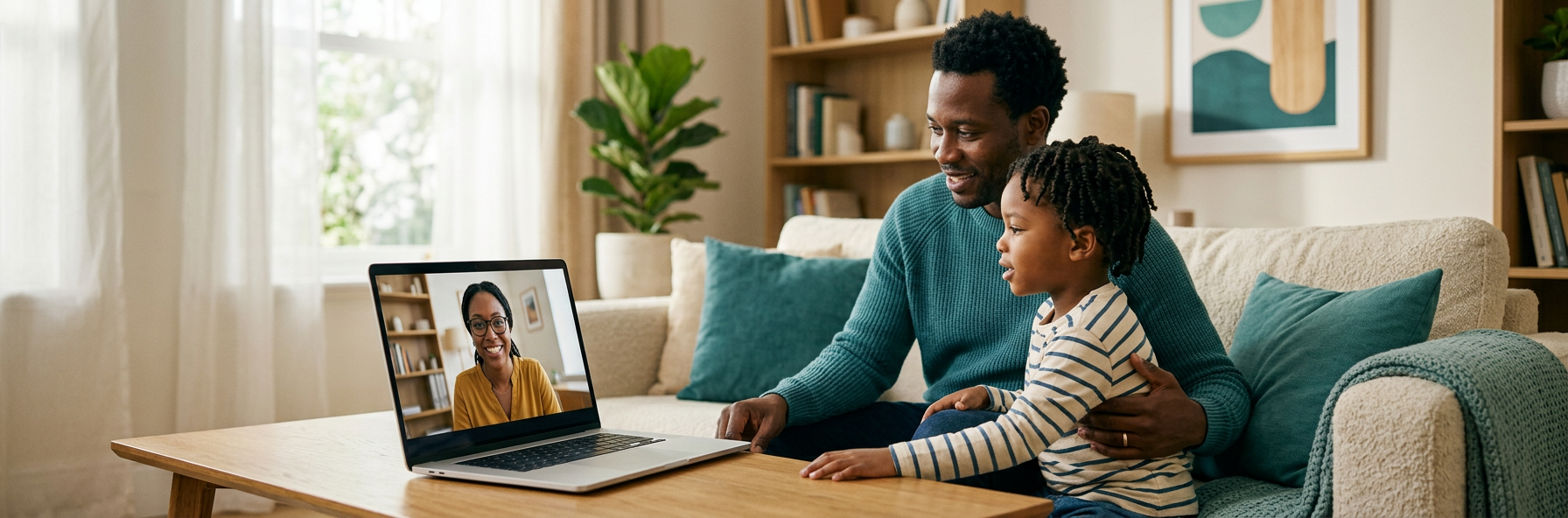
If you have been told that in-person speech therapy is always better than online, you are not alone. It is one of the most common concerns families bring to us before their first session. It is a fair question, and it deserves a real answer.
So here it is: the research shows that telehealth speech therapy produces outcomes comparable to in-person therapy for the vast majority of children and adults. And for some families, it actually works better.
Let us walk through what the evidence actually says, and what that means for your family.
What Researchers Have Actually Found?

Over the past decade, especially following the rapid expansion of telehealth during 2020 and beyond, researchers have studied the effectiveness of telepractice in speech-language pathology more rigorously than ever before.
Here is a summary of what the evidence shows:
• Gabel et al. (2013) examined articulation therapy delivered via telepractice and found no significant difference in outcomes compared to in-person treatment for school-age children.
• Grogan-Johnson et al. (2011) studied children receiving speech sound therapy via videoconferencing and found improvements equivalent to those achieved in traditional clinic settings.
• The American Speech-Language-Hearing Association (ASHA) recognizes telepractice as an appropriate service delivery model for speech-language pathology and has published evidence maps showing strong support for its use across a wide range of conditions.
• A 2021 systematic review published in the International Journal of Speech-Language Pathology concluded that telepractice is effective for a range of communication disorders, with high rates of client satisfaction.
These are not small pilot studies. The evidence base has grown substantially, and the consensus among clinicians and researchers is clear: for most people, online speech therapy works.
Where Telehealth Has Unique Advantages?
Beyond simply matching in-person outcomes, telehealth offers some benefits that the clinic simply cannot replicate.
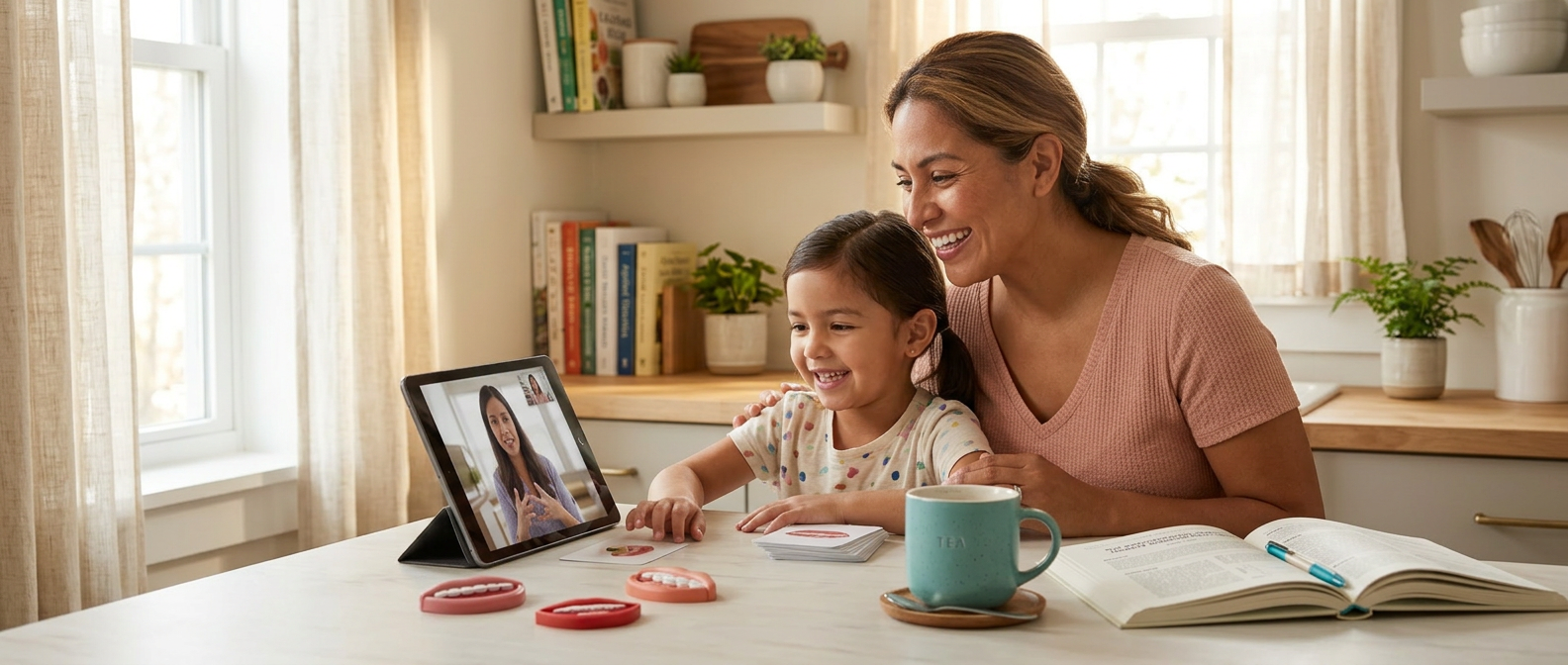
• The familiar environment effect. Children often perform better and generalize new skills faster when therapy happens at home, in the space where they actually communicate day to day. The clinic is a controlled setting, home is where real life happens.
• More consistent attendance. Fewer sessions get cancelled. No traffic, no sick siblings, no 45-minute drives. Families who use telehealth often attend more sessions per month than those traveling to a clinic and consistency is one of the strongest predictors of progress in speech therapy.
• Parent involvement. When a parent can sit beside their child during every session, they see exactly what the SLP is doing and why. That means better home practice, better carry-over, and a stronger team around the child.
Access where it matters. For families in rural Florida, west Texas, or anyone juggling multiple commitments, multiple kids, or an impossible schedule, telehealth is not a compromise. It is the only option that actually works.
Online vs. In-Person Speech Therapy: A Quick Comparison
| In-Person Speech Therapy | Telehealth Speech Therapy |
|---|---|
| Must travel to a clinic | Sessions from home — zero commute |
| Fixed clinic hours | Flexible scheduling including evenings and weekends |
| Child in an unfamiliar setting | Child in their own comfortable environment |
| Harder for parents to observe | Parents watch and learn every session |
| Weather, traffic, and illness cause cancellations | Fewer missed sessions overall |
| Access limited by geography | Any family in Florida or Texas can be served |
| Comparable outcomes for most conditions | Comparable outcomes — with added benefits |
How Oasis Speech Maintains Quality in Every Session?
Evidence-based outcomes do not happen automatically — they happen because of how therapy is structured and delivered. Here is what we do to make every telehealth session count:
Our Telehealth Quality Standards
- ✓ Sessions are delivered via TheraPlatform — a HIPAA-compliant, secure video platform built specifically for healthcare providers
- ✓ Every session begins with a brief check-in and warm-up to orient your child to the session
- ✓ Activities are designed to be engaging and screen-friendly — digital games, flashcards, and interactive tools children genuinely enjoy
- ✓ Data is collected during every session so we can track progress objectively, not just by feel
- ✓ Every session ends with a brief parent debrief — you always know what we worked on and what to practice at home
- ✓ Home practice guidance is provided after every session so learning continues between appointments
This structure is not accidental. It reflects what the research tells us produces results: consistent sessions, active parent involvement, clear goals, and regular data tracking.
The Bottom Line
The question is not whether telehealth speech therapy works. The research answers that clearly: it does, for most people, in most situations.
The better question is whether it will work for your child or your loved one ,and the only way to answer that is to start. We offer a free consultation so you can meet our SLP, ask every question you have, and decide if we are the right fit.
If you have already read our guide on how a telehealth session actually works, you know how simple the process is. If you have not, that is a great next step.
The research supports it. Your schedule will thank you.
Ready to Try It Yourself?
The research supports it. Your schedule will thank you.
Continue Reading
→ How Telehealth Speech Therapy Works — A Step-by-Step Guide (Week 5 Blog)
→ Meet Sahar Owais, MS, CCC-SLP — About Oasis Speech (About Us Page)
