

Fluency & Articulation Disorders
Your speech has always been a challenge. Confidence and clarity can improve. Expert telehealth coaching helps overcome lifelong fluency and articulation patterns — from home.
You've stuttered your whole life. Or certain sounds have always been hard to say. Maybe you learned to compensate — avoiding certain words, keeping quiet in meetings, or feeling self-conscious when speaking. Or maybe your stutter worsened recently due to stress or neurological changes.
Adult-onset fluency and articulation disorders can result from stroke, brain injury, or progressive neurological disease. Either way, speech challenges affect confidence, career, and relationships.
Here's the hope: Adult fluency and articulation disorders respond to therapy. Even if you've struggled for decades, targeted speech therapy — especially telehealth, which removes barriers to frequent sessions — can improve speech clarity and fluency significantly.
What Are Fluency and Articulation Disorders in Adults?
Fluency disorders (stuttering, cluttering) interrupt smooth speech flow — repetitions, prolongations, blocks, or irregular pacing.
Articulation disorders mean difficulty producing certain sounds clearly — distorted consonants, substitutions, or omissions.
In adults, these can be:
Lifelong — Persistent since childhood
Acquired — Resulting from stroke, brain injury, or progressive disease (Parkinson's, ALS)

Red Flags
Stuttering or stutter worsening
Difficulty with specific sound production
Speech avoidance or anxiety
Impact on work or social participation
Sudden speech changes (possible stroke/neurological event)
Speech fatigue or effort
Why This Happens
Lifelong: Neurological differences in speech motor planning and timing.
Acquired: Stroke, TBI, Parkinson's, ALS, ataxia, or other neurological conditions affecting motor control or language processing.
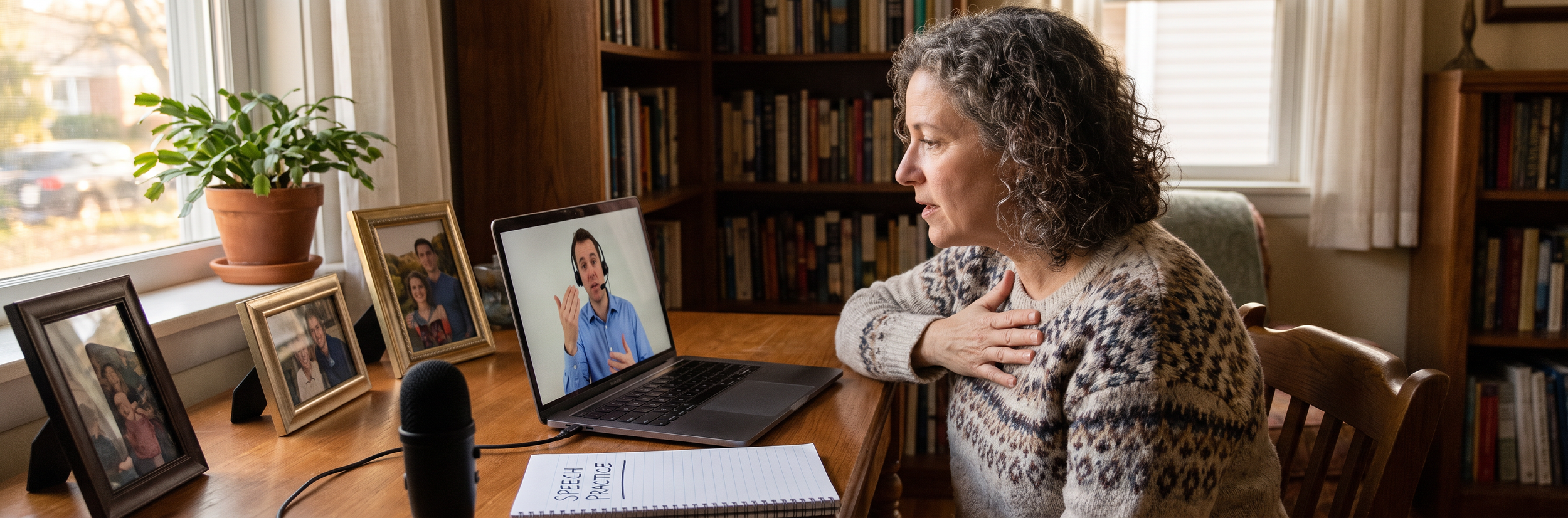
How Telehealth Speech Therapy Helps
Frequent, intensive therapy. Fluency and articulation respond best to regular practice. Telehealth removes barriers, making multiple sessions weekly feasible.
Real-world practice. Therapy focuses on functional communication — work conversations, presentations, social situations — not isolated sound drills.
Confidence building. Speech therapy includes cognitive-behavioral strategies to reduce anxiety and avoidance.
Compensatory strategies. Therapists teach practical techniques: easy onsets, slower pacing, breathing exercises, sound production cues.
Telehealth naturalness. At home, your loved one communicates more naturally than in clinical settings.
Most adults see meaningful improvement within 8–12 weeks of consistent therapy.
What You Can Do Right Now
Listen patiently. Don't rush or finish sentences.
Reduce pressure. Create a relaxed speaking environment.
Avoid drawing attention to errors. Let them finish naturally.
Model fluent, clear speech. Speak slowly and deliberately.
Encourage participation. Include them in conversations despite speech challenges.
Celebrate effort. Speaking with fluency/articulation challenges is hard work.
The Bottom Line
Fluency and articulation disorders are treatable at any age. Telehealth speech therapy removes barriers and puts expert coaching directly into your home, helping restore confidence and communication effectiveness.
Ready to Get Answers?
At Oasis Speech, we work with adults experiencing fluency and articulation disorders — whether lifelong or acquired — via telehealth and help restore speech fluency and communication confidence — all from the comfort of your home. We complete evaluations within one week and work with families throughout Florida and Texas via secure video sessions. No waiting lists. No commute. No guesswork.
You will work with Sahar Owais, MS, CCC-SLP, a licensed speech-language pathologist with extensive experience helping adults improve speech fluency, articulation, and communication confidence. Sessions are evidence-based, intensive, and tailored to your specific needs and communication goals. You'll be coached live on how to support speech improvement every day through fluency techniques, articulation practice, breathing strategies, and confidence-building approaches that restore clarity and ease in your work conversations and personal interactions.