
Speech Sound Milestones by Age: Is My Child on Track?

There is a question almost every parent asks at some point, usually late at night after a long day, when they are replaying the day in their head.
Is my child supposed to be talking more by now?
Maybe your child's teacher said something that stuck with you. Maybe their cousin at the same age was chatting in full sentences. Maybe a friend mentioned that her son said his first word at nine months, and now you are second-guessing everything.
Here is the truth: speech development does not move in a straight line, and no two children are the same. But milestones exist for a reason. They are based on decades of research into how most children develop, and they give us a reliable starting point for knowing when everything is going well and when a closer look might help.
This post guides you through what to expect from 12 months to 5 years, what normal variation looks like, and what it means when a child is not quite meeting their milestones.
Why Milestones Are Ranges, Not Deadlines
Before we get into the numbers, one important thing to keep in mind: milestones are ranges. They describe what most children are doing by a certain age, not what every single child must do on a specific date.
Some children say their first word at 10 months. Others wait until 14 or 15 months. Both can be completely fine. The milestone tells us that most children have a first word somewhere between 12 and 15 months, so if a child is approaching 18 months with no words at all, that is when we want to pay attention.
The goal of milestones is not to create anxiety; it is to give you a map. When something falls significantly outside the expected range, that is useful information. Not a verdict, not a diagnosis. Just a signal worth following up on.
Speech & Language Milestones at a Glance
Here is what research from the CDC and the American Speech-Language-Hearing Association (ASHA) tells us about typical speech and language development:
| Age | What most children are doing | When to be concerned |
|---|---|---|
| 12–18 months |
Says 1–5 words ("mama," "dada," "no"). Babbles with varied sounds. Points to things they want. | No babbling by 12 months. No words by 16 months. No pointing or gesturing. |
| 18–24 months |
Uses 20–50 words. Starts combining two words ("more milk," "daddy go"). Names familiar objects. | Fewer than 20 words by 18 months. No two-word combinations by 24 months. Lost words they previously had. |
| 2–3 years |
Uses short sentences (3–4 words). Strangers understand about 50–75% of speech. Follows two-step directions. | Strangers understand less than half of speech. Can't follow simple instructions. Very limited vocabulary. |
| 3–4 years |
Speaks in full sentences (4–5 words). Strangers understand most speech. Asks questions. Tells simple stories. | Hard to understand even for parents. Can't retell simple events. Avoids talking around unfamiliar people. |
| 4–5 years |
Uses long, complex sentences. Tells detailed stories. Asks "why" constantly. Speech is clear almost all the time. | Strangers frequently can't understand them. Significant sound errors on common words. Struggles with multi-step directions. |
Sources: CDC Developmental Milestones (cdc.gov) · ASHA How Does Your Child Hear and Talk? (asha.org)
12–18 Months: First Words and Babbling
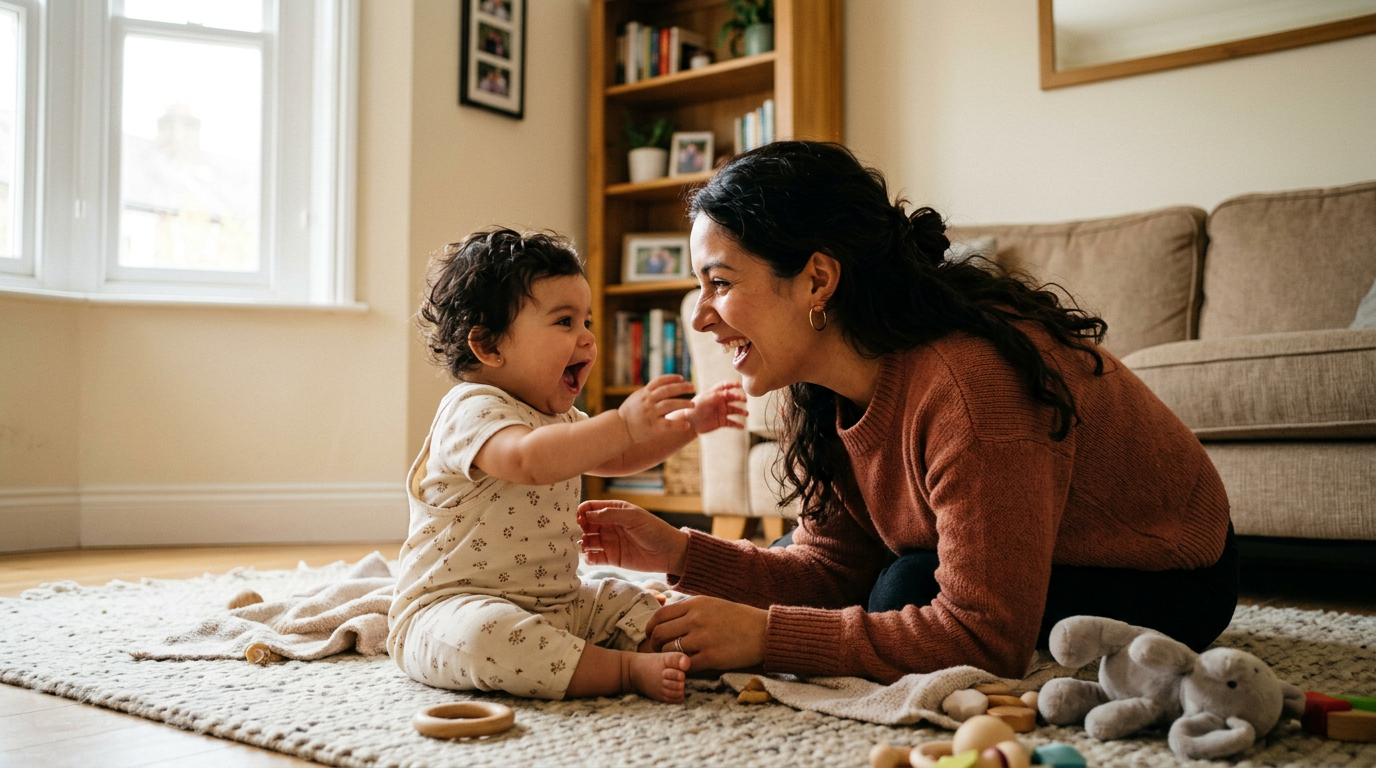
This is a big window for first words. Most children say their first recognizable word somewhere between 10 and 14 months, things like 'mama,' 'dada,' 'no,' or 'more.' By 18 months, most children have somewhere between 10 and 20 words in their vocabulary.
Babbling is also important here. It is how children practice the sounds they will eventually use in real words. A child who is babbling with varied sounds, 'bababa,' 'mamama,' 'dadada', is doing exactly what they should be doing.
What to watch for: No babbling by 12 months, no words by 16 months, or a child who has lost words they previously used. Any of these warrants a conversation with a speech-language pathologist.
18–24 Months: Two-Word Combinations
This is the stage where vocabulary starts to really take off and where children start connecting two words. 'More milk.' 'Daddy go.' 'Big dog.' These two-word combinations are a major leap. They show that a child is not just memorizing words but starting to understand how language works.
By 24 months, most children have a vocabulary of 50 or more words and are combining two words regularly. They can also follow simple two-step directions, like 'get your shoes and bring them here.'
What to watch for: Fewer than 50 words by 24 months, no two-word combinations, difficulty following simple instructions, or any regression in skills already developed.
2–3 Years: Short Sentences and Clearer Speech
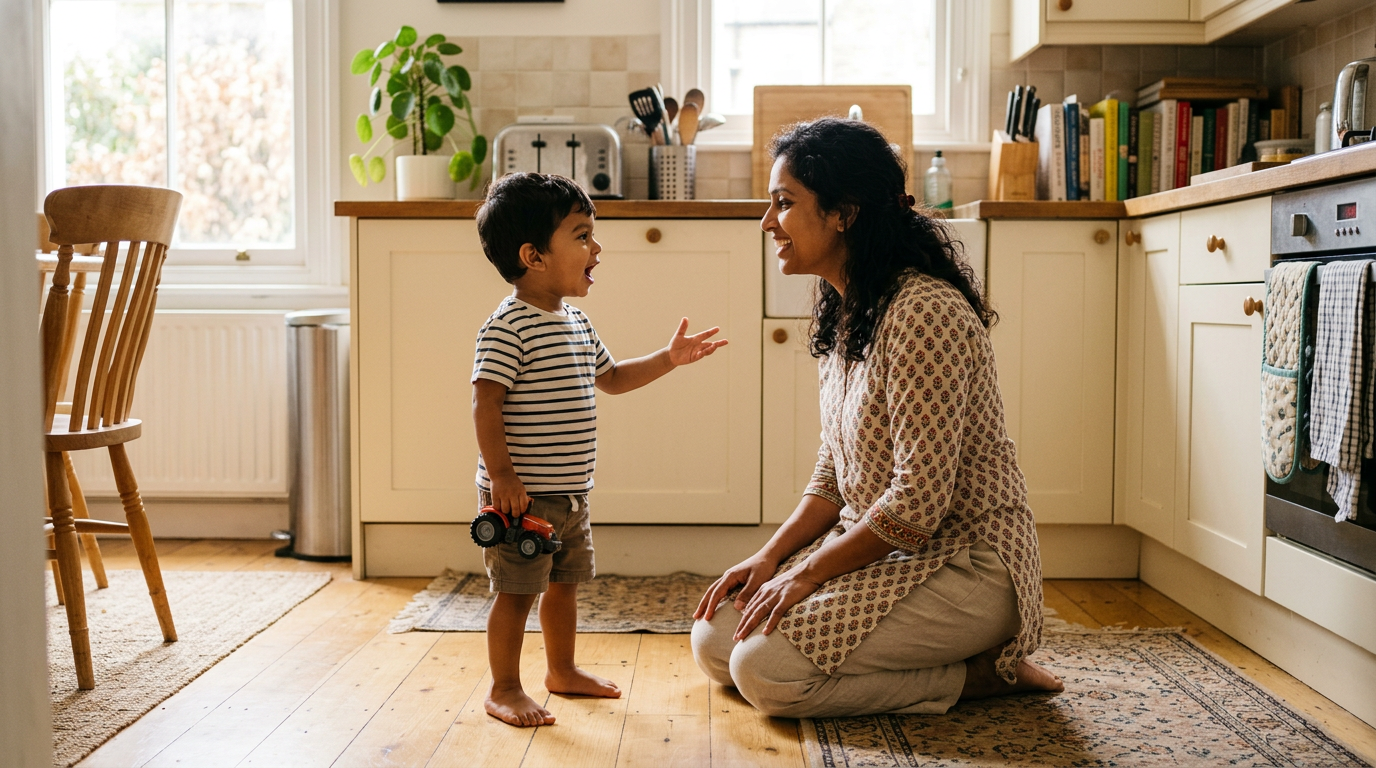
Between their second and third birthday, children move from two-word combinations to short sentences — usually three to four words. Vocabulary is expanding quickly. They start asking questions ('What's that?') and talking about things that happened earlier in the day.
A helpful marker at this age: by age 2, parents should understand about 50% of what their child says. By age 3, strangers — people who do not know the child — should understand about 75% of what they say. If a child's speech is consistently unclear even to the people who know them best, that is worth looking into.
What to watch for: Speech that is very difficult for parents to understand, inability to follow two-step instructions, little interest in talking with other children.
3–4 Years: Full Sentences and Storytelling
By this age, most children are speaking in full sentences of four to five words or more. They can tell you about their day. They can describe what happened in a book. They ask questions constantly, especially 'why.'
Strangers should now understand most of what a 3- to 4-year-old says. Speech sounds will still not be perfect at this stage, sounds like 'r,' 'l,' 'th,' and 's' blends are still developing, but overall, a child's speech should be mostly clear and understandable.
What to watch for: Sentences that are consistently short or incomplete, speech that even parents struggle to understand, difficulty retelling simple events, or a child who avoids talking around unfamiliar people.
4–5 Years: Complex Language and Clear Speech
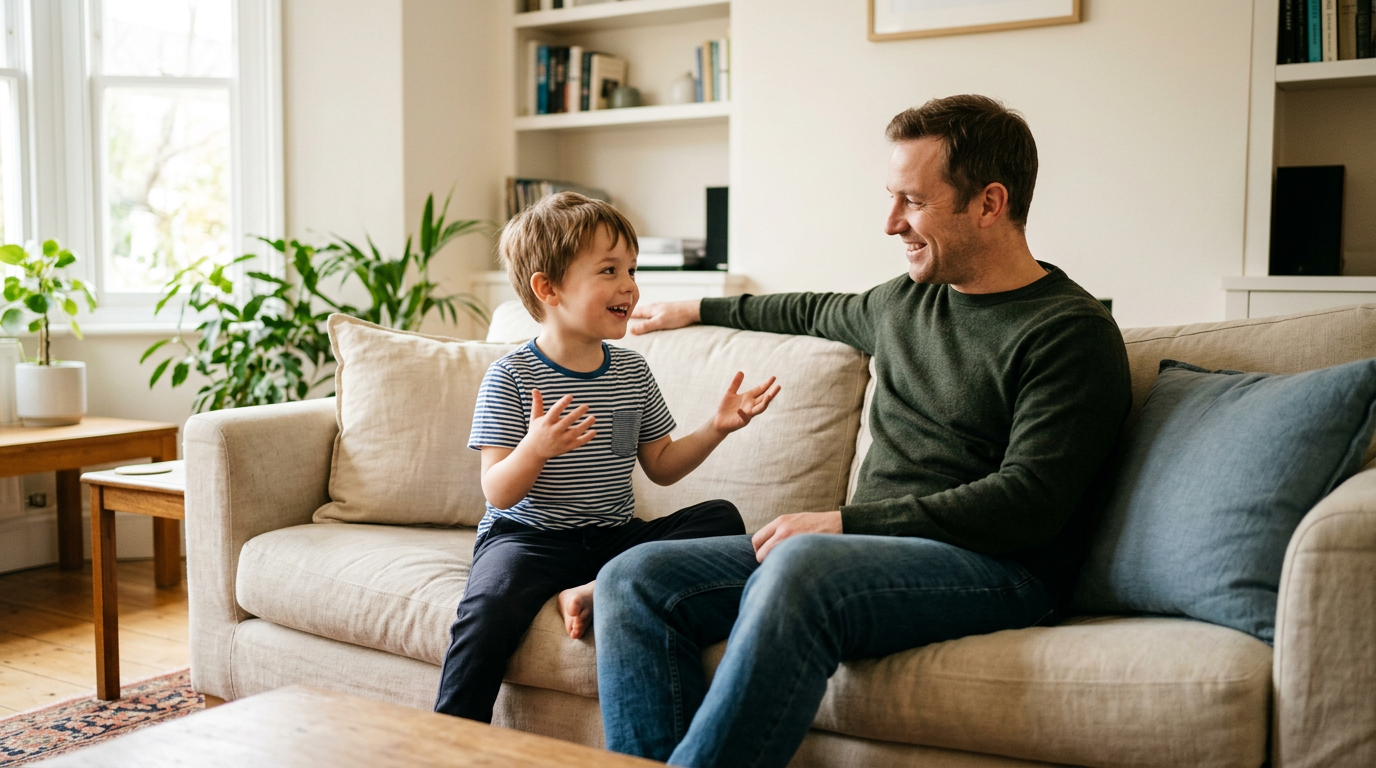
By age four or five, children are using complex sentences with multiple clauses. They can tell detailed stories with a beginning, middle, and end. They understand rules, follow multi-step directions, and engage in real back-and-forth conversations.
Speech should be clear almost all the time by age five. Most sounds should be correct, or very close to it. The 'r' sound is often one of the last to click into place, typically by age 6 or 7, so that one alone is not a red flag. But overall intelligibility should be very high.
What to watch for: Speech that is still frequently unclear, significant sound errors on common words, difficulty following multi-step directions, or trouble understanding or participating in conversations.
What To Do If Your Child Isn't Hitting Their Milestones

The most important thing: do not wait and hope it resolves on its own. Some children do catch up without support. But many do not, and every month without intervention is time that cannot be recovered.
Early evaluation is low-stakes and high-reward. A speech-language pathologist will assess your child's speech and language development, tell you clearly what they are seeing, and help you understand whether therapy is needed and what it would look like.
You do not need a doctor's referral to book an evaluation. You do not need to prove that something is definitely wrong. If you have a concern, that is enough reason to reach out.
Here is what the research says consistently, from ASHA and from decades of clinical practice: early intervention leads to significantly better outcomes. The brain is most flexible in the early years. The earlier a child gets the right support, the further they can go.
One More Thing: Trust What You're Noticing
Parents are often the first to notice that something is different, before teachers, before doctors. You know your child. You hear them every day. If something feels off to you, even if you cannot quite put it into words, that instinct is worth listening to.
Getting an evaluation does not mean something is wrong. It means you are paying attention. And it means your child gets the best possible start.
Don't sit with it. Book a consultation.
Not Sure If Your Child Is on Track?
Book a free consultation and we'll walk you through it. Evaluations completed within one week.
Book Free ConsultationCONTINUE READING
→ 5 Signs Your Child May Need a Speech Evaluation (Week 3 Blog)
→ Book Your Child's Evaluation at Oasis Speech (Evaluations Page)
